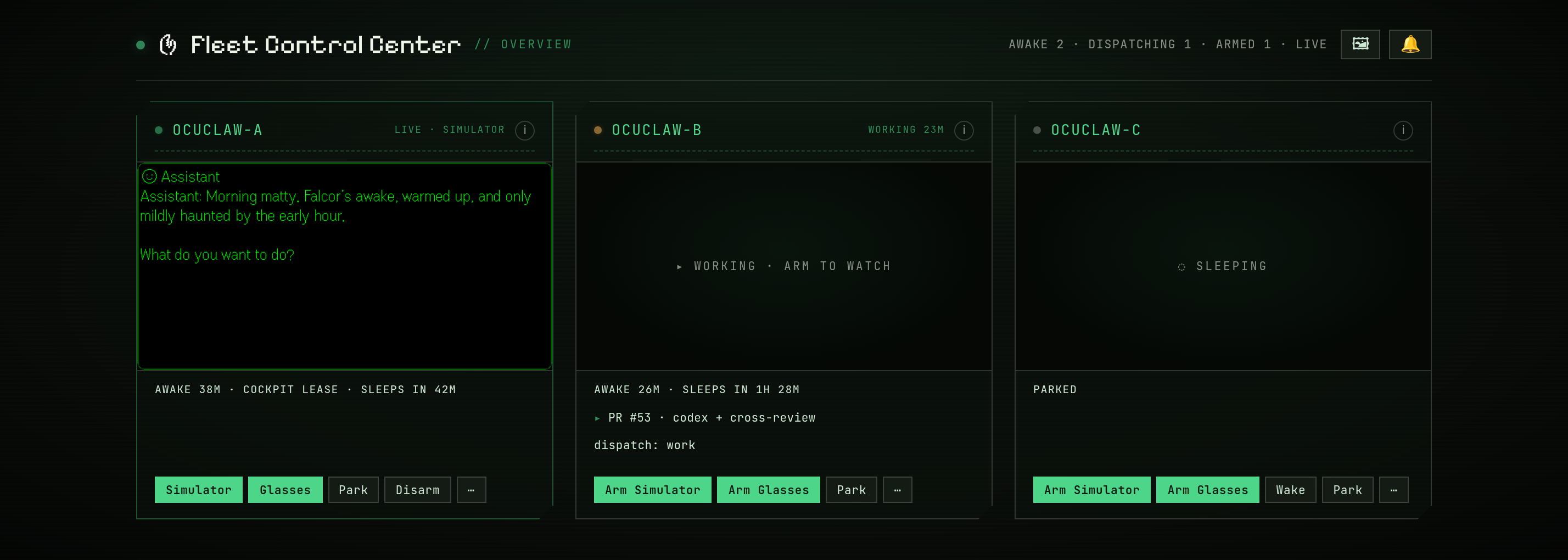
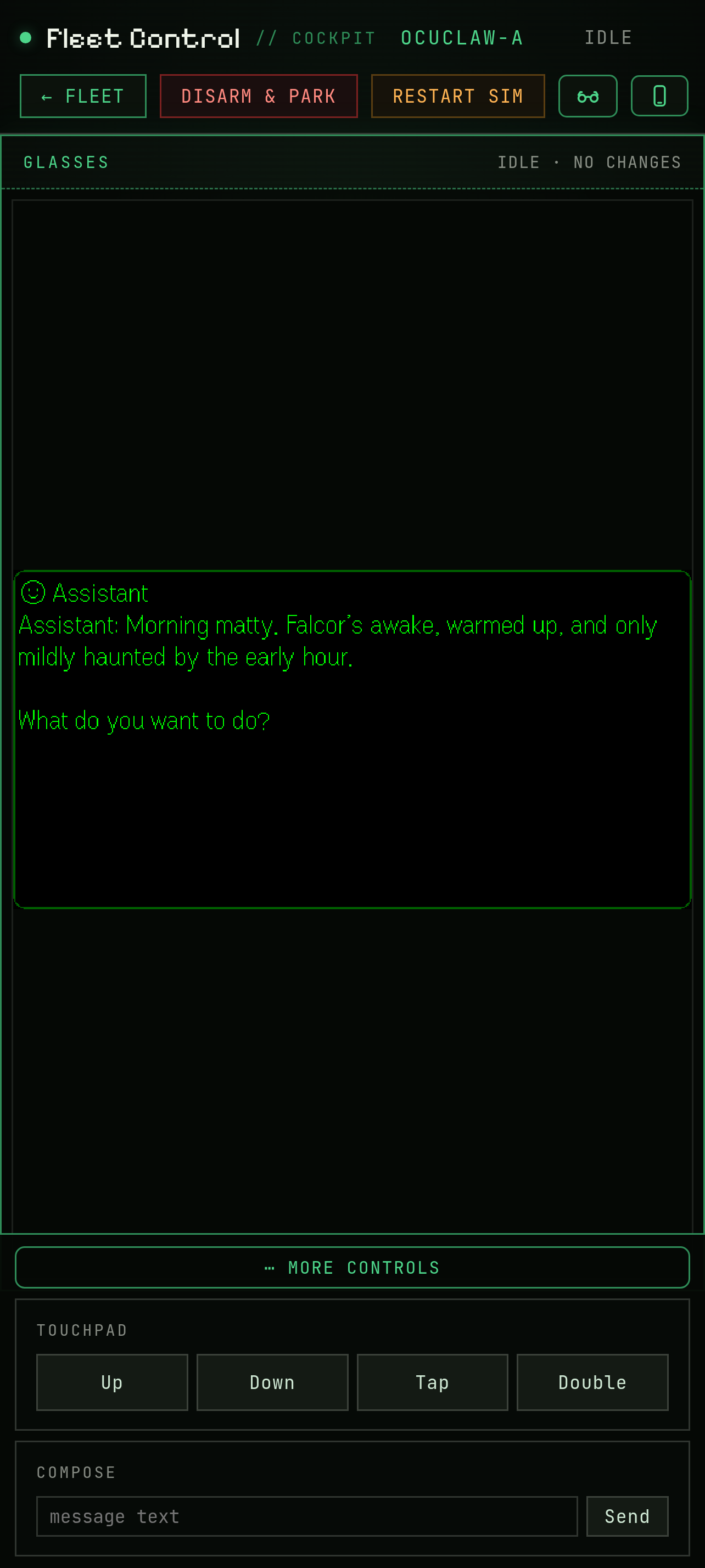
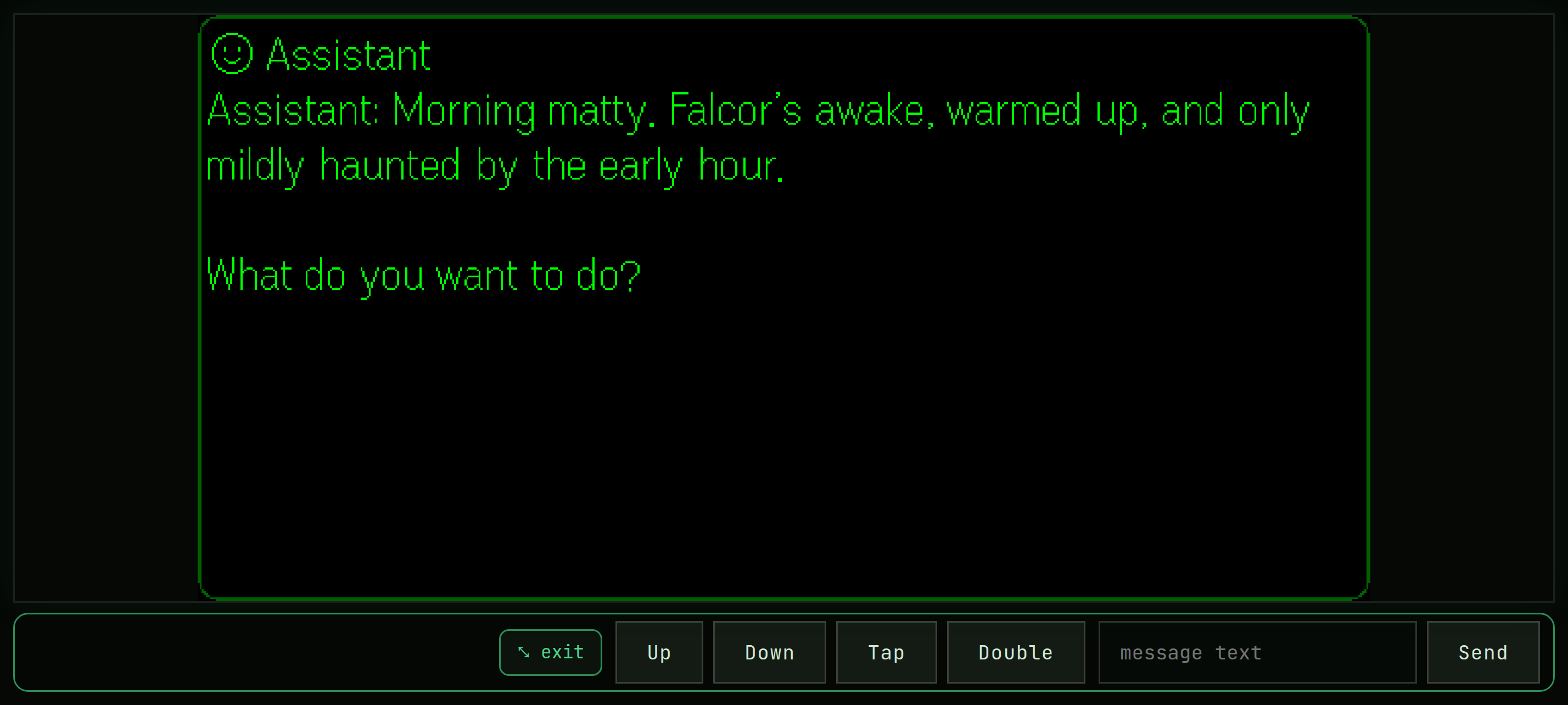
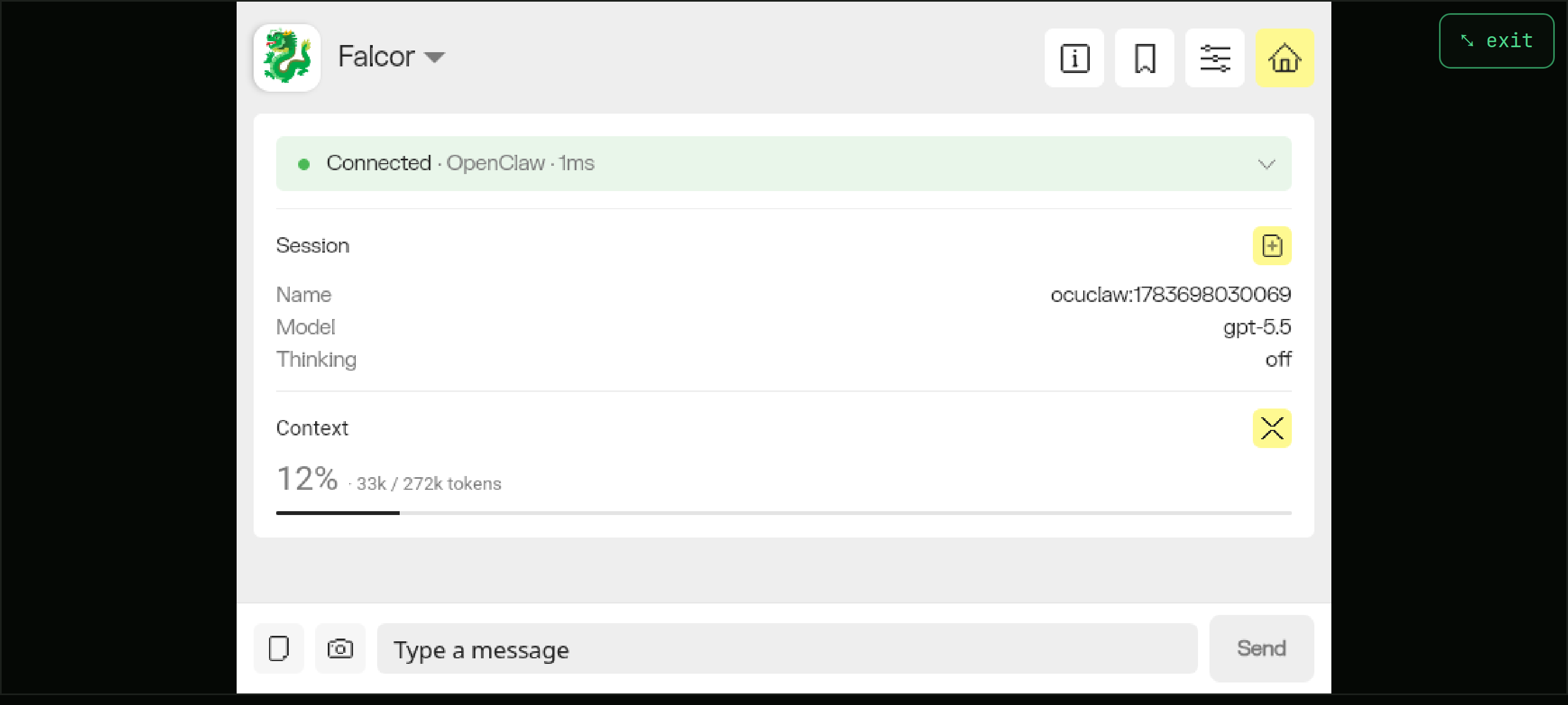
OcuClaw puts AI agents on Even Realities' Even Hub and the G2 smart glasses — born an OpenClaw client, now speaking Hermes Agent too. One change means exercising a Kotlin app, an OpenClaw plugin, a Hermes Agent plugin, and a relay together through a G2 simulator and real hardware. Fleet Control Center turns that single-machine grind into a fleet of ready boxes you drive from one screen — or your phone, or the glasses themselves. Run many build-and-test cycles at once, watch any box's live glasses or phone UI, and move branches between sim, phone, and G2 lanes.
Plain commands and natural language on top. Underneath, it handles the per-box relays, private tunnels, renewable leases, the one-client rule, and the single tailnet door — so you never have to think about any of it.
The browser talks only to the fleet backend (fleet-cc) on an always-on home-lab server — the one
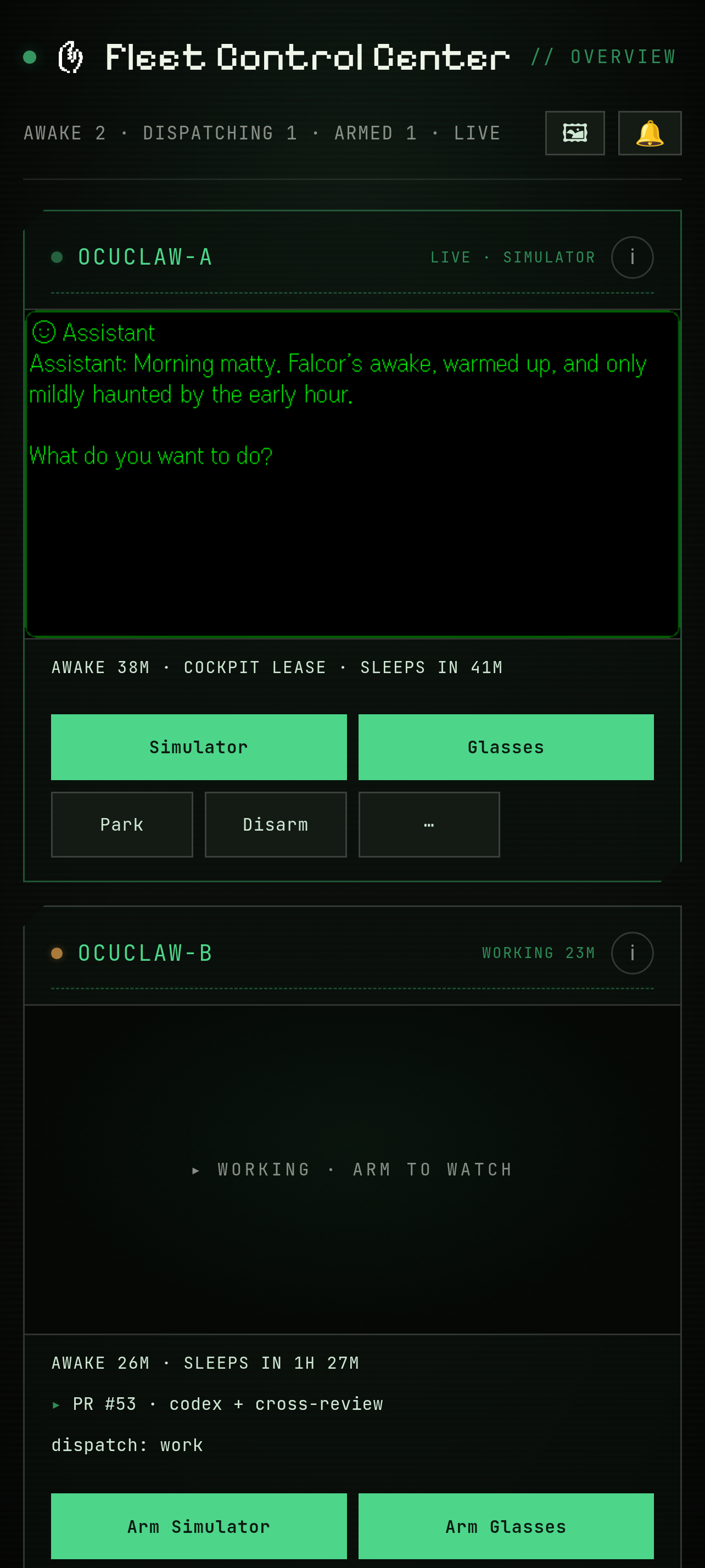
piece that never sleeps, idling at ~25 W on the tailnet — which proxies into each box over private tunnels. Three ways to use a live box: overview (parked boxes stay cold; armed ones show a live glasses thumbnail),
cockpit (drive one live — glasses-first panes, deeper controls one tap away), and phone (your phone becomes the
box's client). Temporary *.sprites.app URLs are a separate static-build lane; the live relay stays private.
flowchart TB
classDef you fill:#0e1622,stroke:#7ad3ff,color:#dbeeff,stroke-width:1px;
classDef cc fill:#0c1a10,stroke:#4dd58a,color:#dff5e6,stroke-width:1.2px;
classDef box fill:#1a1408,stroke:#ffb454,color:#ffe7c2,stroke-width:1px;
classDef edge fill:#1a0e12,stroke:#ff8798,color:#ffd9df,stroke-width:1px;
BR["💻 PC browser · 📱 mobile PWA<br/>overview · cockpit"]:::you
PH["📱 phone + 👓 G2 glasses — Even Hub app"]:::you
subgraph PC["fleet-cc backend · home-lab server · 24/7 on the tailnet"]
direction LR
OV["overview"]:::cc
CKP["cockpit<br/>render + real input"]:::cc
PHL["phone lane<br/>origin + relay-bridge"]:::cc
end
TS["tailscale serve<br/>per box · tailnet-private"]:::edge
subgraph FLEET["3 primary boxes · public app box · scratch + lab boxes on demand"]
direction LR
A["ocuclaw-a"]:::box
B["ocuclaw-b"]:::box
C["ocuclaw-c"]:::box
P["public app box"]:::box
end
BR --> OV
BR --> CKP
PH --> TS --> PHL
OV -.->|"status poll"| FLEET
CKP ==>|"proxy tunnels"| FLEET
PHL ==>|"proxy tunnels"| FLEET
This is where the fleet earns its keep. Dispatch a self-contained task and the box runs the whole cycle on
its own, detached — it survives your disconnect. Fire several at once across the fleet and walk away:
different branches, no shared state, no waiting. You come back to finished branches and DONE mail. Codex and
Claude are both headless dispatch engines, each cross-reviewed by the other one on the box, so every DONE
carries a second opinion and a review.txt — and when the box exercised the simulator, an
agent-recorded evidence clip lands in its gallery, so you can watch the feature actually run before you
fetch and open the PR. Every DONE also carries a harness signature — one that arrives without it is quarantined,
not counted.
flowchart TB
classDef you fill:#0e1622,stroke:#7ad3ff,color:#dbeeff,stroke-width:1px;
classDef box fill:#1a1408,stroke:#ffb454,color:#ffe7c2,stroke-width:1px;
classDef cc fill:#0c1a10,stroke:#4dd58a,color:#dff5e6,stroke-width:1.2px;
T["your task<br/>theory / prompt"]:::you --> FO["dispatch · codex or claude<br/>fan out across the fleet"]:::cc
FO --> A["ocuclaw-a"]:::box
FO --> B["ocuclaw-b"]:::box
FO --> C["ocuclaw-c"]:::box
A & B & C --> L
subgraph L["self-driving loop · per box · detached"]
direction LR
S1["sync trunk"] --> S2["agent writes code"] --> S3["build"] --> S4["G2 sim validate"] --> S5["cross-engine autoreview"] --> G{"clean?"}
G -->|no| S2
G -->|yes| S6["push branch<br/>+ DONE mail"]
end
S6 --> PR["you: git fetch → review → open / merge PR"]:::you
The fleet rides on Sprites, Fly's stateful-sandbox platform. Each box is a hardware-isolated Firecracker microVM with a persistent filesystem — a real Linux computer that's still there, exactly as you left it, the moment it wakes. Live copy-on-write checkpoints land in around 300 ms, a recently-parked box restores and reconnects in under a second — a fully cold one is back in a second or two, services restarting themselves — and an idle box hibernates at near-zero cost. Sprites is purpose-built to run AI agents — which is exactly what each box does — so you keep as many as you like, parked cold, and only pay for the seconds one is actually working.
A standard-spec Sprite (8 vCPU · 2–16 GB autoscaling memory · 100 GB disk) running its own
OpenClaw and Hermes Agent gateways & relays, G2 simulator, and a dev server for the OcuClaw app itself.
Everything binds to loopback and is reached over private tunnels; one standing public box fronts the static app
build, and temporary *.sprites.app doors open — and are torn down with the box — when a build must
reach someone off the tailnet. The G2 sim runs headless under a virtual display — the same simulator as the
host, no GPU needed.
| Service | Role |
|---|---|
| OcuClaw app :4173 | Dev server for the OcuClaw client app (your build). Loopback-only — the one standing public box is where a static build gets web-fronted. Auto-starts on first hit. |
| simulator | The G2 sim, headless. The box's one app client in the cockpit. Captured to the live render. |
| OpenClaw + Hermes gateways & relays | Both runtimes' gateways run real, billed agent turns; the relays stay loopback/private and power the live phone lane. |
| input shim | On-demand. Turns your clicks and keystrokes into real OS input on the sim — no second client. |
| codex + claude CLIs | Two independent coding engines, logged in and ready for dispatch — each cross-reviews the other's work. |
| validation suite | The ~4,100-test suite a dispatched branch has to clear before the box calls it good. |
| fleet machinery | Box-side dispatch harness, watchdog, and heartbeat telemetry, riding the box's own Tailscale tunnel. |
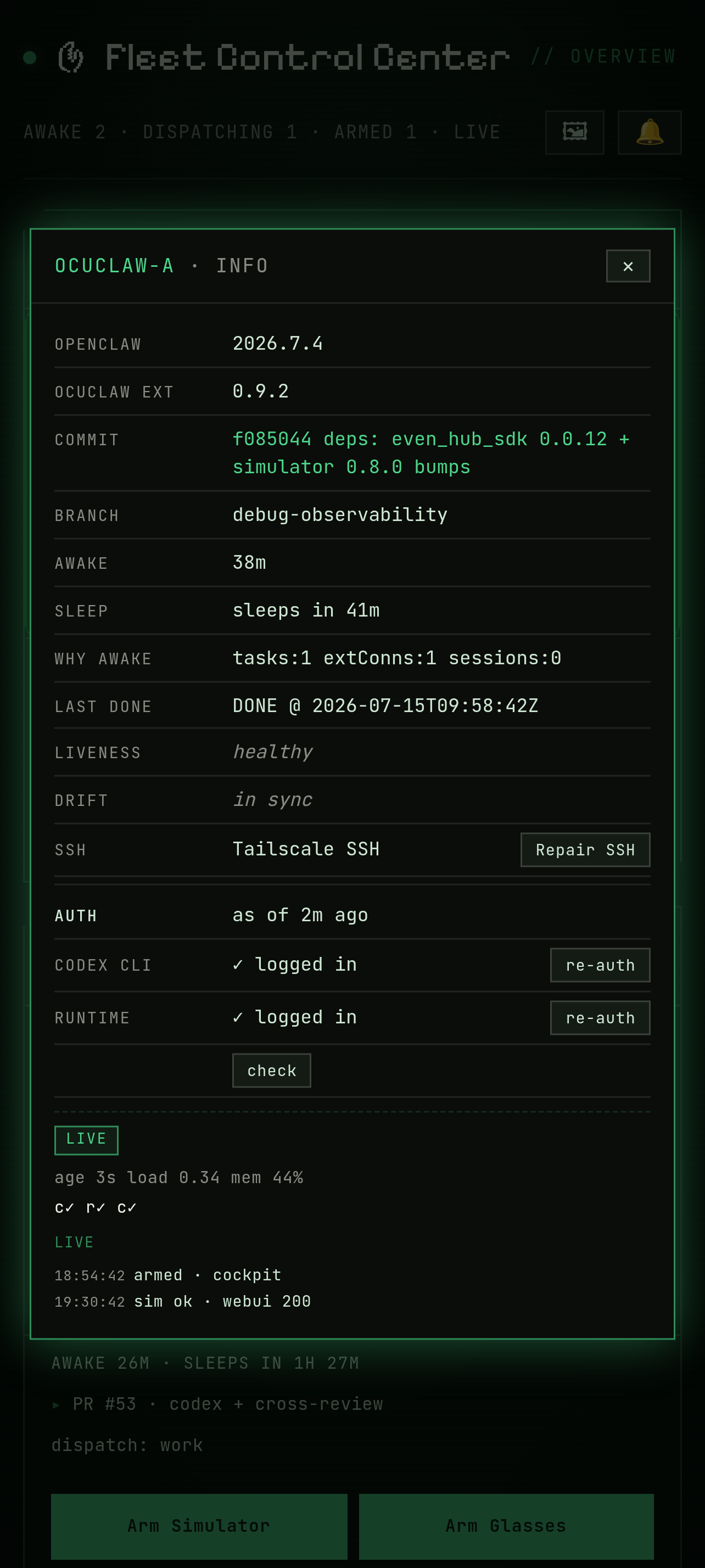
| auth + health | Fleet CC surfaces Codex/Claude CLI logins, runtime login, gateway/model health, telemetry state, and re-auth actions per box. |
A phone arm stops the box's sim and hands the phone the role of the single client. The home-lab server serves the box at a private per-box address; Fleet CC shows a QR or direct Even Hub link over the tailnet. Real input, real voice, real agent — just not on the public internet.
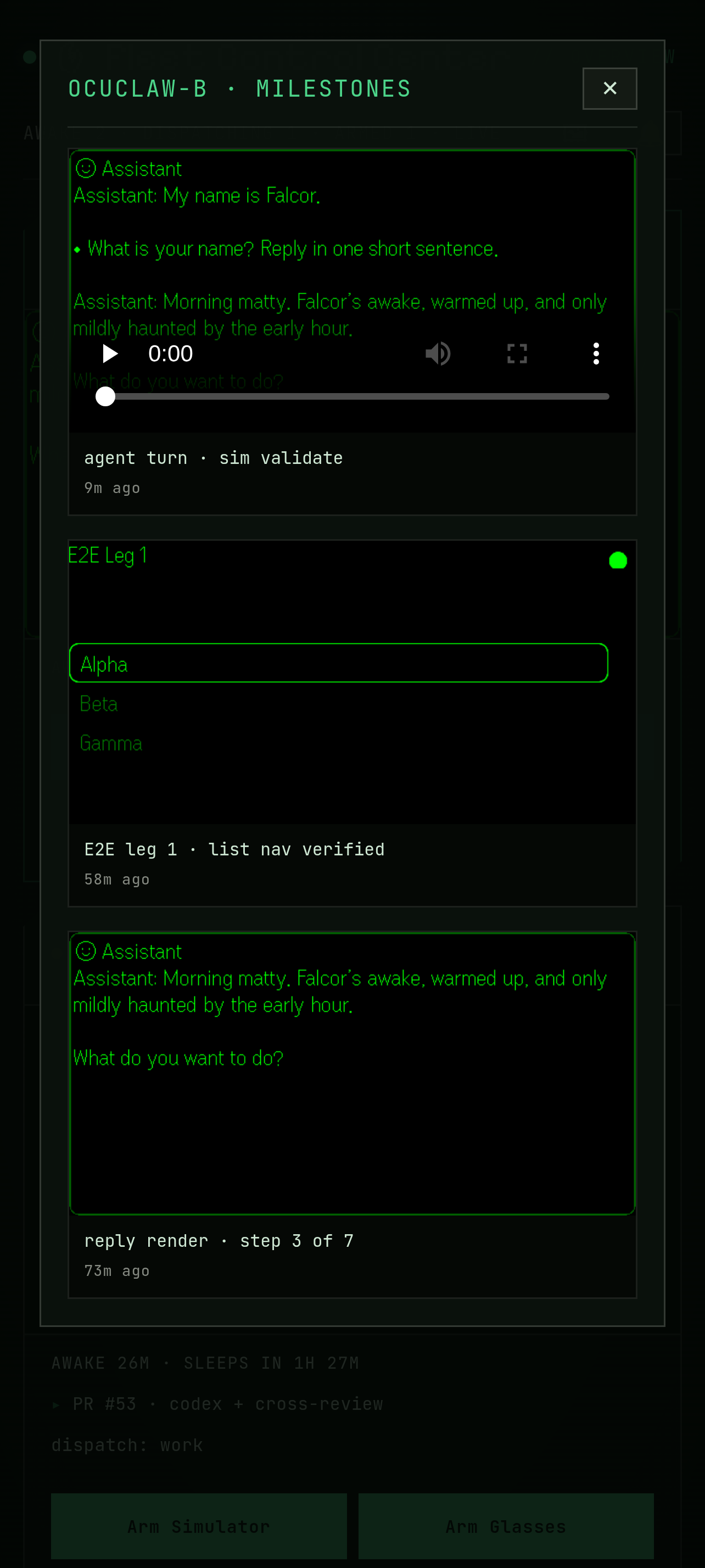
That's one of two ways onto your phone. The other: install the control center itself as a PWA and drive the whole fleet from your phone's browser — overview, cockpit, fullscreen glasses, milestone pushes, and per-box galleries of screenshots and evidence clips.
Behind all of this is a stack of precise commands. The ocuclaw-fleet skill puts a natural-language front on them: you describe the work — a smoke test, a feature with full E2E coverage, a branch on real G2 — and it picks the right verbs, runs them, and reports back. One terminal does it all — and the same thing works from your phone, since the always-on home-lab server answers natural language too. Reversible asks just run; anything that costs money or destroys state stops to confirm first.
Under the hood it's an intent router: your sentence maps to the right verbs — status,
dispatch, sim-arm, login-status, setup-codex, park —
run against spritectl, fleet-cc, and mail, then summarized back to you.
Each box is baked from a branch and saved as a checkpoint — that checkpoint is what parks and wakes again in moments. Fleet CC keeps branch, commit, auth, gateway, and telemetry health one tap away on every box, so freshness is visible before you spend a long rebuild.
ocuclaw-* boxes show up as limited lab entries when they exist.setup-codex repairs Codex/OpenClaw tooling without a full rebuild.*.sprites.app URLs are temporary static-build doors; widening hosts or auth still asks first.